


BURMA AND THE ROHINGYA MUSLIMS
- Independent & Al Jazeera
- 7 sept 2017
- 2 Min. de lectura
The Rohingya are often described as "the world's most persecuted minority".
They are an ethnic Muslim group who have lived for centuries in the majority Buddhist Myanmar. Currently, there are about 1.1 million Rohingya Muslims who live in the Southeast Asian country.
The Rohingya speak Rohingya or Ruaingga, a dialect that is distinct to others spoken in Rakhine State and throughout Myanmar. They are not considered one of the country's 135 official ethnic groups and have been denied citizenship in Myanmar since 1982, which has effectively rendered them stateless.
Muslims have lived in the area now known as Myanmar since as early as the 12th century, according to many historians and Rohingya groups.
After the killings of nine border police in October 2016, troops started pouring into villages in Rakhine State. The government blamed what it called fighters from an armed Rohingya group. The killings led to a security crackdown on villages where Rohingya lived. During the crackdown, government troops were accused of an array of human rights abuses, including extrajudicial killing, rape and arson - allegations the government denied.
In November 2016, a UN official accused the government of carrying out "ethnic cleansing" of Rohingya Muslims. It was not the first time such an accusation has been made.
In April 2013, for example, HRW said Myanmar was conducting a campaign of ethnic cleansing against the Rohingya. The government has consistently denied such accusations.
Most recently, Myanmar's military has imposed a crackdown on the country's Rohingya population after police posts and an army base were attacked in late August.
Residents and activists have described scenes of troops firing indiscriminately at unarmed Rohingya men, women and children. The government, however, has said nearly 100 people were killed after armed men from the Arakan Rohingya Salvation Army (ARSA) launched a raid on police outposts in the region.
Since the violence erupted, rights groups have documented fires burning in at least 10 areas of Myanmar's Rakhine State. More than 50,000 people have fled the violence, with thousands trapped in a no-man's land between the two countries.
According to the UN, hundreds of civilians who have tried to enter Bangladesh have been pushed back by patrols. Many have also been detained and forcibly returned to Myanmar.
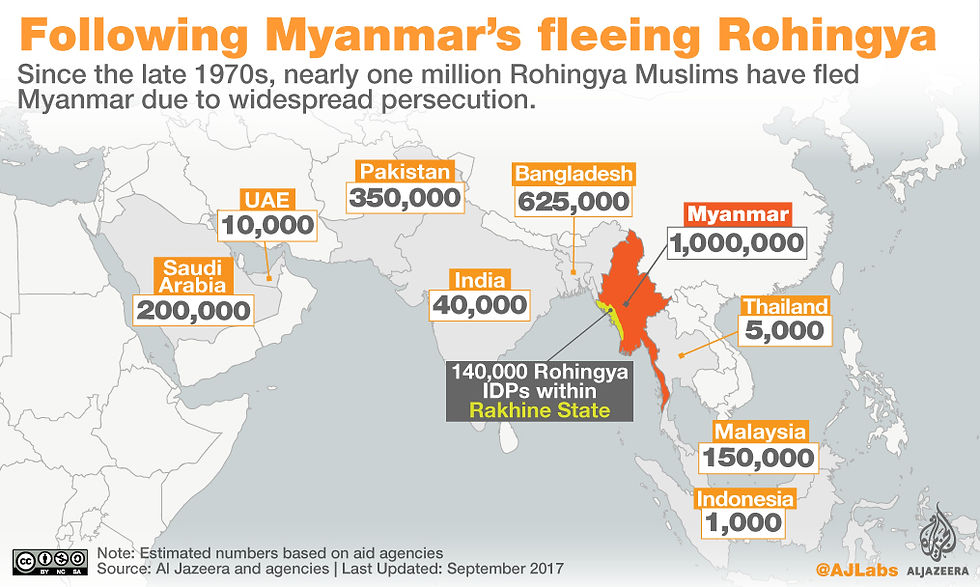
Almost 400 people have died in clashes between security forces and Rohingya Muslims in Burma, the country's military commander has said.
The numbers, posted on the military's official Facebook page, are a sharp increase on the previously reported toll of just over 100. The statement said all but 29 of the 399 dead were insurgents, whom it described as terrorists.
The statement said there had been 90 armed clashes including an initial 30 attacks by insurgents on 25 August, making the combat more extensive than previously announced.
The Burmese government has repeatedly denied claims the Rohingya are facing genocide. It previously brushed away evidence of human rights violations as fake news and "propaganda".
Bangladeshi border guards have tried to keep out the fleeing Rohingya, but thousands could be seen on Friday making their way across muddy rice fields.
Young people helped carry the elderly, some on makeshift stretchers, and children carried newborns.


Comentarios